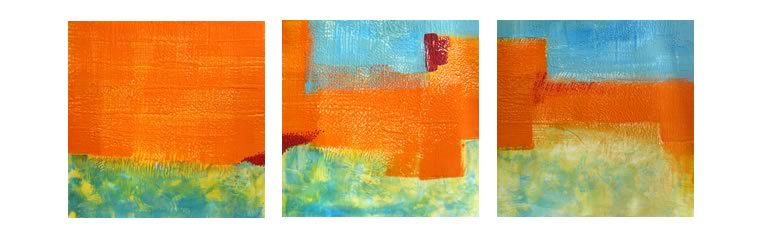
 Pictured Above: Orange Tide, triptych, 2006, encaustic on dibond, each panel 32 x 32 in.
For over 25 years,
Sondra Arkin has transformed whatever space was available to her at that given point in time (spare bedroom, dining room or basement) into a
haven for creative expression. Although art-making was always in her blood throughout the course of her life, it wasn't until 2001 that Sondra took a risk and quit her day job in marketing to pursue art full-time. This huge
leap of faith resulted in a myriad of awards, features in newspapers such as
The Washington Post, participation in both group/solo shows all over the mid-Atlantic region and most recently, working as a project curator on behalf of the DC Commission on the Arts & Humanities on the new
City Hall Art Collection @t the John A. Wilson Building downtown. Sondra's colorful, abstract, mixed media canvases, which rival those of
Mark Rothko, and imaginative box-construction works have been widely received by local and national audiences alike. She is also a frequent exhibitor at our gallery and will be featured in the
Third Annual Attainable Art Show, opening November 24th.
What strikes me the most about Sondra Arkin's work is her ability to create art that is both purposeful and powerful. No matter the size, material used or color combinations (only warm or cool colors, a combination of the two, a more monochromatic palate), Sondra's work never ceases to create a lasting impression for all who come into contact with it. It is not abstract for the sake of being non-representational, but
abstract to evoke every little emotion that is hiding behind our imperfect, human façade. There is a distinct type of [positive] energy in her work that forces the viewer to pause, observe and think beyond what is physically represented on the canvas. Furthermore, Sondra's free style of painting caters to just about anyone:
the hip, young art school student to children learning their colors for the first time, spiritual soul-seekers and even to those in the professional world who value high aesthetics.
In recent years, Sondra Arkin's unique encaustic (otherwise known as "hot wax painting", which uses heated beeswax to which colored pigments are added -- dates back to 100-300 AD) technique has led the artist to break
free from the picture plane approach and make paintings that take on a more sculptural feel. Now, her compositions are not only conceptual and vibrant, but also boast a soft, playfulness of colors that echoes a dichotomy of the combination of diverse materials. She also extends her experimentation of focusing simply on individual work with the inclusion of diptypchs, triptypchs and polytptychs, thereby
proding the viewers to look at these pieces as a whole and enhance the conversations further.
Those who attended the
Color: Field Tests show back in April/May of this year may remember Sondra's involvement to help promote the citywide
Color Field Remix -- a movement from the 1960s that emerged after
Abstract Expressionism and is widely characterized by abstract canvases painted with large areas of solid colors. Her entire oeuvre, be it a mixed media collage/box of found objects or a spiritual landscape of vibrant layers of warm colors, has the power to communicate a positive message to the masses:
that life, as we know it, is comprised of layers, both good and bad. We as
humans will experience both highs and lows in this journey called life, but these feelings are necessary as we stretch, evolve and grow.
Ultimately, Sondra hopes that what surfaces out of these layers of influence is something of value and beauty. By encouraging her viewers to take an introspective approach while confronted with her artwork, Sondra desires that a
tangible layer will then be added to our respective lives, which will hopefully enrich it all the more.
 Krzystof Kokoryn, Duet (2005) 31.5 x 39.5 oil on canvas
 Krzysztof Kokoryn, Bar (2002)


